A book about AI. Mostly about you.
AI is making you faster. Is it making you smarter?
Most people are learning to use AI. Few are learning to think with it.
This book shows you how, without handing over your judgment.
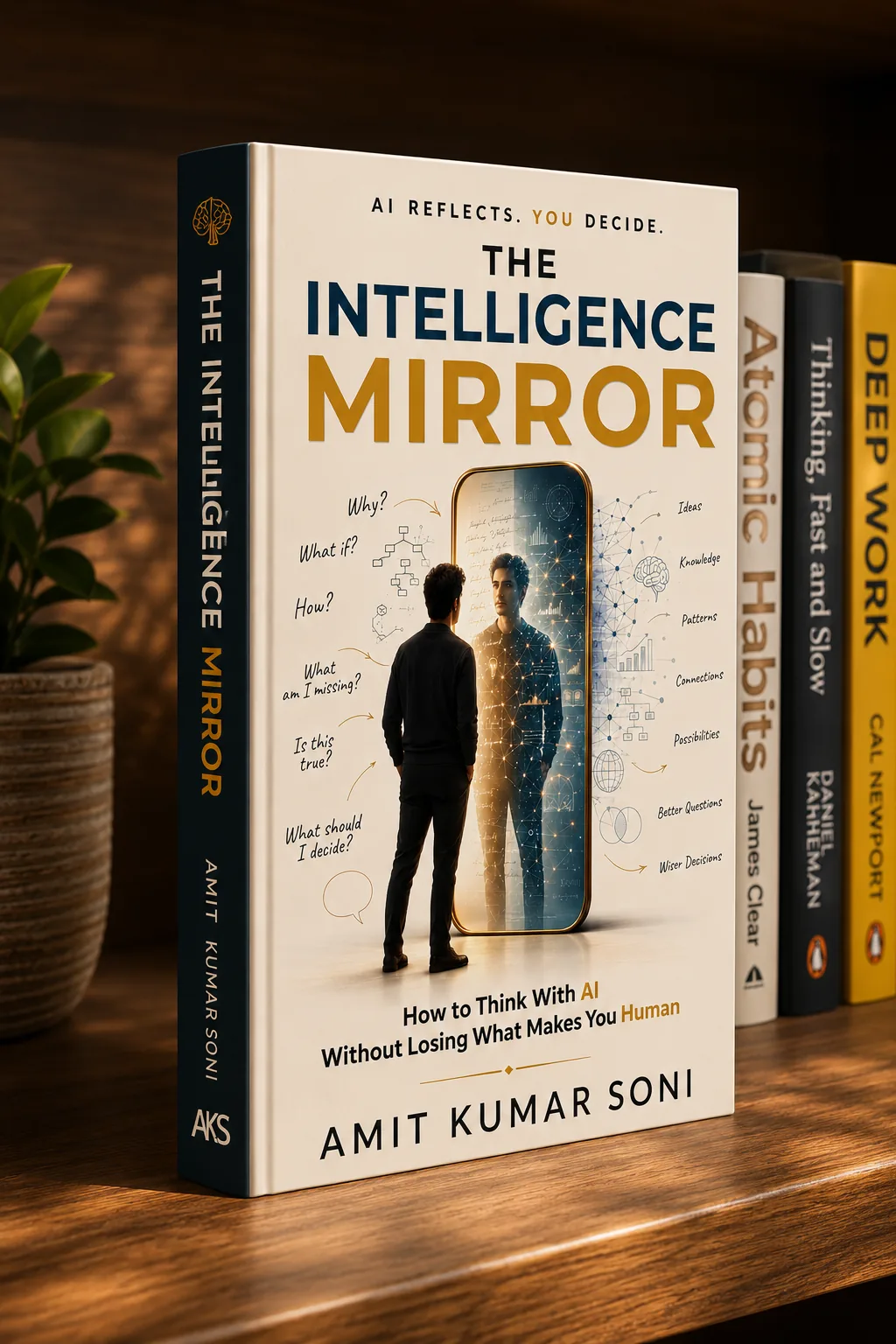
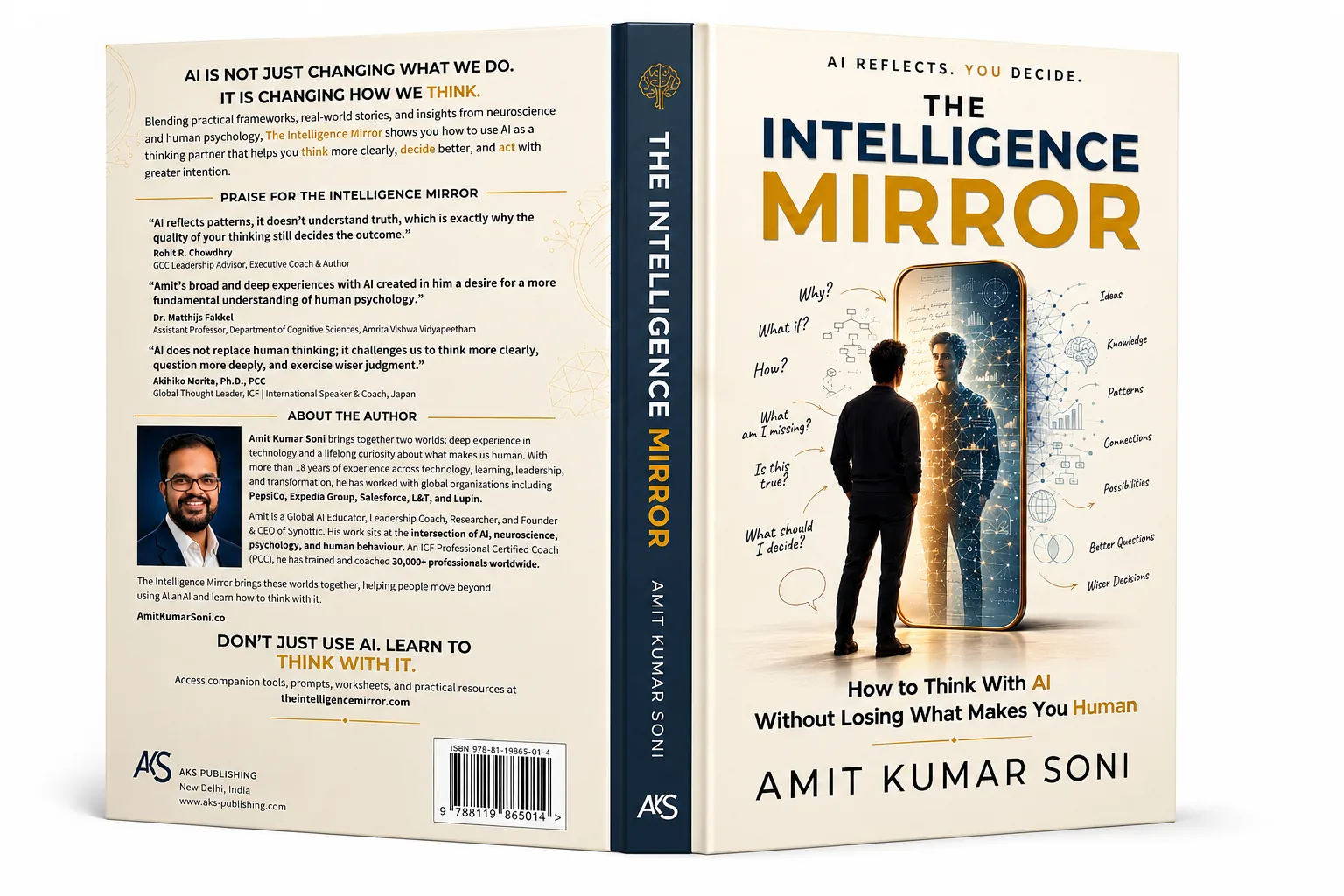
The Intelligence Mirror
How to Think With AI Without Losing What Makes You Human
AI Reflects. You Decide.

AI can do the work. It can't do your thinking.
Using AI isn't the danger. Leaning on it is.
Lean too long and your own judgment quietly stops leading. Use AI as a spotter, not an elevator.
| AI can help you | AI cannot decide for you |
|---|---|
| Explore | What matters |
| Create | What is true |
| Summarise | What is right |
| Reframe | What you should choose |
| Generate | What you should own |
The gap between those two columns is where this book lives.
This book is for you if...
You use AI every day, and you're not sure it's making you better at your job.
You've pasted an AI answer into an email and hoped nobody would check it.
You've avoided AI, and the feeling of falling behind is getting louder.
You want AI's speed without losing your own edge.
You lead people who ask you about AI, and "it depends" no longer feels like enough.
You don't code, and you're tired of AI books written for people who do.
Which one sounds like you?
Most people fall into one of two traps with AI.
Trap one
AI is magic
“It knows everything.”
Trap two
AI is useless
“It can't really understand my work.”
AI is a mirror.
- It reflects patterns.
- It can amplify your thinking.
- It can expose assumptions.
- It can accelerate work.
But you still decide what deserves to be trusted.
Are you using AI to think better, or to avoid thinking?
Days of work. Now done in under an hour.
A team in Pune put together the same monthly report every month.
Before
2 to 3 days
- Multiple people
- Multiple formats
- Waiting
- Rework
Before you hit send.
Would you sign your name under this?
You asked AI
Why did customer churn rise last quarter, and what should we do?
AI answered
Churn rose 18% last quarter, driven mainly by the pricing change in March. Companies that reverse a price increase recover 70% of lost customers within two quarters. Recommendation: roll back the March pricing immediately.
An illustrative AI answer. The figures are invented to make a point.
Six habits, one mirror.
The MIRROR framework is one practice for thinking with AI.
Each habit is small enough to start this week, and each one builds on the habit before it.
- M
Meet
See AI clearly.
- I
Inquire
Ask with purpose.
- R
Recheck
Question the answer.
- R
Redesign
Change the shape of the work.
- O
Own
Keep important decisions human.
- R
Rise
Keep learning and help others grow.
When you need something concrete
MIRROR is the journey. These are the tools you pick up along the way, each a free card or template you can use today.
- RCTFA way to ask better questions: Role, Context, Task, Format.Serves Inquire · The RCTF Prompt Template
- SIFTA fast method for checking AI outputs before you rely on them.Serves Recheck · The SIFT Card
- FLOWA way to redesign the work, not just speed it up.Serves Redesign · The FLOW Card
- COREThe human capabilities worth protecting as AI gets more capable.Serves Own · The CORE Card
- TRUSTA guide for deciding how far to trust AI, and using it responsibly.Serves Own · The TRUST Card
- Mind-FirstHuman intelligence leads. Artificial intelligence amplifies.Serves Rise · The Mind-First Leadership Assessment
Monday morning, after the last page.
What you'll be able to do.
You do not need to become an AI expert. You need to become a better thinker in an AI-enabled world.
- 01
Think before you prompt.
Know what you actually need before you ask for it.
- 02
Give AI better context.
Relevant, not more. The lever most people miss.
- 03
Spot answers that need checking.
Recognise when confident output still needs verification.
- 04
Redesign work, not just speed it up.
Rebuild the flow around what AI genuinely does well.
- 05
See where AI adds value.
And where it quietly costs you.
- 06
Protect important decisions.
Keep judgment, values, and the final call human.
- 07
Use AI responsibly.
Privacy, bias, confidentiality, and accountability, made practical.
- 08
Build a learning habit that lasts.
A weekly practice that outlives any single tool.
- 09
Help other people adapt.
Lead the conversation about AI on your team.
What early readers noticed.
Leaders, coaches, engineers, and academics in India, Japan, Australia, and Bulgaria read the book before publication.
The advantage was never in using AI, it's in thinking with it.
AI does not replace human thinking; it challenges us to think more clearly, question more deeply, and exercise wiser judgment.
On clearer thinking
This book is a clear guide to engaging AI as a multiplier of human intelligence, capacity and clarity.
Amar CheguPractising Growth Enabler, India Amit's broad and deep experiences with AI created in him a desire for a more fundamental understanding of human psychology.
Dr. Matthijs FakkelAssistant Professor, Department of Cognitive Sciences, Amrita Vishwa Vidyapeetham, India This book will help readers move beyond simply using AI to thinking better with AI - a capability that will define the future of work.
Dr Hari Prasad N.Founder & CEO, HospitalHR™, India
On practical use
The “Honest Map” is the standout, showing clearly where AI is strong and where it can mislead you.
Jayesh MistryEx Head of Engineering, L&T, India The Intelligence Mirror is a timely and practical guide that makes AI simple, relevant, and accessible.
Rituraj SarFounder, The Now Company | Former VP & Head, Learning & Development, Lupin Limited It is meant to demystify what AI can do and what its boundaries are.
Hitesh DalalVP Digital Transformation, Reliance Industries, India
On human judgment
Through this book, Amit invites us to look at AI not as something that will dominate or replace us, but as a tool, and perhaps a mirror, that can amplify the best of who we are.
Hélio Mariz SatoSenior IT Consultant and Program Manager, Japan In a world captivated by artificial intelligence, The Intelligence Mirror reminds us that our greatest strength will always be our humanity.
Lilia IanevaEsthetician and Health Coach, Bulgaria It encourages readers to embrace AI not just as a productivity tool, but as a thought partner that must be used with responsibility, critical thinking, and human judgment.
Shalu MahawalCEO & Founder, DataMatrixIQ, Australia
On leadership
Capability without judgment rarely converts into advantage - that's as true of AI as it is of leadership.
Rohit R. ChowdhryGCC Leadership Advisor, Executive Coach & Author, India
A book for the same shelf.
The Intelligence Mirror sits beside the books that changed how people think about habits, decisions, and focused work. It brings the same practical lens to a newer question: how to stay sharp while you think alongside AI.
Fifteen chapters. Start with the five lies.
Chapter 3 is called The Five Lies You've Been Told About AI. You've probably believed at least one of them.
- See it clearly
- AI Is Not Magic. It's a Mirror.Meet Your New InternThe Five Lies You've Been Told About AI
- Talk to it well
- The Art of Asking WellGive It the Full PictureCatching AI When It's Wrong
- Put it to work
- Your Starter Toolkit, and How to Actually Use ItHow AI Learns Your WorkRedesign the Work, Don't Just Speed It Up
- Protect what matters
- What AI Still Can't DoProtecting Your MindBefore You Trust AI
- Lead the future
- The Mind-First LeaderTurning Insight Into HabitReady for Whatever Comes Next
Plus the MIRROR framework, five practical tools, a 90-day practice, and 33 companion resources you can download free today. No email wall.
“The Intelligence Mirror is a timely and thought-provoking book that makes artificial intelligence simple, practical, and understandable for every reader.”
“The Intelligence Mirror is an important contribution that demystifies AI and empowers readers to embrace it with confidence, curiosity, and sound judgment.”

The question behind the book.
For years, Amit has worked across AI, learning, leadership, coaching, neuroscience, psychology, and human development.
Across workshops, coaching conversations, classrooms, and leadership sessions, he kept meeting the same question.
As AI becomes more capable, how do we make sure human thinking becomes stronger, not weaker?
This book is his answer. Global AI educator, leadership coach, researcher, and founder of Synottic, with more than eighteen years across technology, learning, and leadership.
Amit Kumar Soni · ICF Professional Certified Coach (PCC)
Read the full story →Fair questions.
What readers ask about The Intelligence Mirror.
Is this just a book about prompts?
No. One chapter teaches a simple structure for asking well (RCTF: Role, Context, Task, Format), but the book's focus is the thinking around the prompt: knowing what you need before you ask, giving relevant context, checking what comes back, redesigning the work, and keeping important decisions human. Better prompts begin with better thinking.
I already use ChatGPT. Is this still useful for me?
Yes, and arguably more so. Daily users are the people most exposed to trusting fluent answers too quickly or offloading thinking they should keep. The Recheck, Redesign, and Own habits are written for exactly that situation, with tools like the SIFT Card and the Cognitive Fitness Check to make them practical.
I'm not using AI much yet. Am I already behind?
The book is written so you can start from wherever you are. Part One, See It Clearly, begins with an honest map of what AI can and cannot do, with no jargon assumed, and the free AI Vocabulary Guide covers the terms. Starting with clear thinking is a better foundation than starting with habits you later need to unlearn.
Will this tell me which AI tools to use?
It gives you a starter toolkit in Chapter 7 and a free AI Tools Directory, but tools are not the point. Tools change quickly. The book focuses on the habits that stay useful whichever tool you open: asking well, checking answers, redesigning work, and protecting your judgment.
What will I actually be able to do after reading it?
Think before you prompt, give AI better context, recognise when an answer needs verifying, redesign work instead of only speeding it up, see where AI adds value, protect important decisions, use AI responsibly, build a learning habit that lasts, and help the people around you adapt.
Is the book useful for leaders?
Yes. Part Five, Lead the Future, is written for people who lead others through AI change. It introduces Mind-FIRST leadership, where human intelligence leads and AI amplifies, and comes with practical resources such as the Five-Sentence Script Template, the Mind-First Leadership Assessment, an AI Acceptable-Use Policy Template, and a team discussion guide.
Is this relevant outside technology companies?
Yes. The book is written for professionals in any function who use AI or know they will. The habits it teaches, asking well, checking answers, redesigning work, and keeping decisions human, do not depend on your industry or on writing code.
Does the book include practical exercises?
Yes. It is built to be used, not just read: AI Missions, Mirror Moments, and Chapter Checkpoints run through the chapters, and a 90-Day Practice turns the ideas into a weekly habit.
What resources come with the book?
33 free companion resources: cards, worksheets, trackers, templates, and a complete toolkit including the MIRROR Framework Poster, the Prompt Library, and the 90-Day Practice Planner. They are direct downloads with no email wall, and the same links are printed inside the book.
Can I read a sample before I buy?
Yes. The opening pages and the whole of Chapter 1, AI Is Not Magic. It's a Mirror., are free. Enter your email on the chapter one page and we'll send you a private link to the PDF.
What formats is the book available in?
The Intelligence Mirror is published by Notion Press in paperback (ISBN 979-8-90643-398-5) and hardcover (ISBN 979-8-90817-237-0). Both editions run to 328 pages in a 6 × 9 inch format.
What is The Intelligence Mirror about?
The Intelligence Mirror is a practical guide to how to think with AI without losing your judgment. It treats AI as a mirror that reflects and amplifies the thinking you bring, and draws on neuroscience and human psychology to explain what happens to your decisions when AI starts thinking alongside you. Its six-habit MIRROR framework shows you how to ask better, verify what comes back, and keep the final call human.
Who should read this book?
Professionals, managers, and leaders who already use AI at work, or know they need to, and want to do it without handing over their judgment. It is for anyone who wants AI as a thinking partner rather than a replacement for thinking, and it gives managers concrete AI habits to build with their teams.
What does "outpaced, not replaced" mean?
It is the book's answer to the fear that AI will take your job. For most professionals, the nearer risk is not being replaced by AI but being outpaced by people who have learned to think with it. The skills that close that gap are human ones: better questions, sharper judgment, and the habit of checking what AI tells you.
Is this book for technical or non-technical readers?
It is written for non-technical professionals first. You do not need to code or know how AI models are built: every term is explained in plain language, and the free AI Vocabulary Guide covers the jargon. Technical readers get just as much from it, because the focus is human-centred AI skills like judgment, context, and verification rather than any single tool.
How to avoid over-relying on AI?
Offload the task, never the thinker. Hand AI the work that does not build your capability, like formatting, first drafts, and summaries, and keep forming views, making judgments, and deciding for yourself. The book's Cognitive Fitness Check helps you spot the three quiet stages of over-reliance (dependency, judgment, and identity risk) before they become permanent.
What is workslop, and how does it affect AI-driven work?
Workslop is AI-generated work that looks finished but falls apart once someone checks it. The term comes from 2025 research published in Harvard Business Review, and it matters because the cost does not disappear: it moves to whoever has to catch, question, and redo the work. Chapter 6 shows how to recheck AI output quickly so you never pass workslop on.
What is the illusion of understanding in AI use?
It is the feeling that you understand something because AI explained it fluently, when you could not actually explain it yourself. Fluent, confident answers feel more trustworthy than they may deserve, a point the book draws from research on cognitive ease. A simple test: put the idea in your own words without looking. If you cannot, you borrowed the understanding rather than built it.
What is the Mind First Method?
Mind-FIRST is the book's approach to leading with AI, from Chapters 13 and 14: human intelligence leads while artificial intelligence amplifies. A Mind-FIRST leader measures success by what people become, not by how many tools they adopt, and turns that principle into a lasting weekly habit for the whole team.
Five years from now.
Imagine meeting yourself then, and asking: what should I have learned?
Not which AI tool was popular.
Not which prompt went viral.
But:
- Did I keep learning?
- Did I protect my judgment?
- Did I stay curious?
- Did I learn to work with technology without losing myself?
Start building those habits now.
Get The Intelligence Mirror →